7.2K
Downloads
21
Episodes
The good podcast about bad media influences, investigating the bad faith arguments, dodgy data, and moral panics behind claims that the media influence our behaviour and manipulate our minds.
Episodes
Mar 28, 2024
Mar 28, 2024
1 min
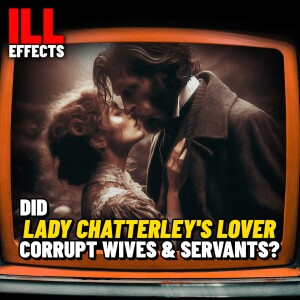
Ben takes Rich back to the landmark case study of a book that was accused of changing the world forever by containing descriptions of sex and swearwords. Join us for a 150-year history of obscenity laws, the power of literature to corrupt, swinging 60s, explicit fan fiction, and whether you’d want YOUR wife or servant reading this filth.
Show Notes:
Chandos, John (1962) To deprave and corrupt...”. Original Studies in the Nature and Definition of 'Obscenity' Associated Press.
Erlanson, Erik, et al. (2020) Forbidden Literature: Case Studies on Censorship. Kriterium.
[Video] Hawes, James (2006) The Chatterley Affair, BBC
Hilliard, Christopher (2013). “Is It a Book That You Would Even Wish Your Wife or Your Servants to Read?” Obscenity Law and the Politics of Reading in Modern England. The American Historical Review, 118(3), 653-678.
[Video] 1960: Lady Chatterley's Lover Goes on Sale
Ozimek, John and Julian Petley (2009) ‘Our outdated obscenity law’, The Guardian, 1st July.
Roberts, M. J. D. (1985). ‘Morals, Art, and the Law: The Passing of the Obscene Publications Act, 1857’, Victorian Studies, 28(4), 609-629.
Rolph, C. H. (1991). The Trial of Lady Chatterley: Regina V. Penguin Books Limited: The Transcript of the Trial. Penguin
Thomas, Nick (2013). “‘To-Night's Big Talking Point is Still that Book’ Popular Responses to the Lady Chatterley Trial”, Cultural and Social History, 10(4), 619-634.
Note: Journal articles are often behind paywalls. If you don't have institutional access but would like a copy of these papers please email Illeffectspod@gmail.com and we will happily send you one.
Credits:
Hosts – Rich McCulloch and Ben Litherland
Music by - Brutalust (Colin Frank and Maria Sappho), recorded and mixed by Joe Christman
Creative producer – Rachel Wood
Technical producer – Caroline Pringle
Technical production – Colin Frank
Mar 14, 2024
Mar 14, 2024
1 hr 14 min
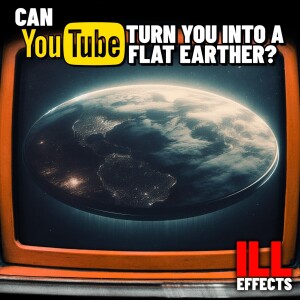
Can the YouTube algorithm really turn you into a Flat Earther, or some other kind of radical conspiracy theorist? Rich takes Ben on a journey through terrible poetry, evangelical newsletters and 9/11 Truther videos. It turns out the “filter bubble” is an idea that might need bursting.
Show Notes:
Sources and links:
Blount, Lady Elizabeth (1898) “The ‘Why’ and ‘Because’” [poem included in her novel Adrian Galilio; Or, a Song Writer’s Story]
Bruns, Axel. (2019) Are Filter Bubbles Real? Polity Press.
Flat Earth News (1976-1994) [Newsletter of the Flat Earth Society]
Garwood, Christine (2008) Flat Earth: The History of an Infamous Idea. Pan Books.
Grusauskaite, Kamile, Luca Carbone, Jaron Harambam, and Stef Aupers (2023). “Debating (in) echo chambers: How culture shapes communication in conspiracy theory networks on YouTube,” New Media & Society. Online First.
Loose Change (2005) Dir. Dylan Avery. [Film]
Olshansky, Alex, Robert M. Peaslee and Asheley R. Landrum (2020) “Flat- Smacked! Converting to Flat Eartherism,” Journal of Media and Religion, 19(2).
Paolillo, John C. (2018) “The Flat Earth phenomenon on YouTube,” First Monday.
Pariser, Eli (2011) The Filter Bubble: What the Internet Is Hiding from You. Penguin Books.
“Phillip Is Absolutely Baffled by the Men Who Believe the Earth Is Flat | This Morning” [Video]
Roose, Kevin (2020) Rabbit Hole, New York Times [Podcast]
Roose, Kevin (2021) “How a Viral Video Bent Reality,” New York Times, September 8.
Russell, Jeffrey Burton (1991) Inventing the Flat Earth. Praeger.
Sales, Nancy Jo (2006) “Click Here for Conspiracy”, Vanity Fair, October 10.
Sunstein, Cass R. (2001) Republic.com. Princeton University Press.
Note: Journal articles are often behind paywalls. If you don't have institutional access but would like a copy of these papers please email Illeffectspod@gmail.com and we will happily send you a copy
Credits:
Hosts – Rich McCulloch and Ben Litherland
Music by - Brutalust (Colin Frank and Maria Sappho), recorded and mixed by Joe Christman
Creative producer – Rachel Wood
Technical producer – Caroline Pringle
Technical production – Colin Frank
Feb 29, 2024
Feb 29, 2024
1 hr 27 min
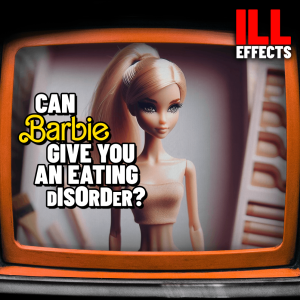
Barbie has been accused of a lot over the last 7 decades, but her most enduring criticism is that she sets unrealistic beauty standards for young girls. Ben talks Rich through the curious history of Barbie as a toy and a “role model”, the sometimes-warped world of body image research, and a creepy life-size doll that walks on all fours.
Show Notes:
[Video] CNN: Woman Makes Life-Size Barbie Look-Alike
Blood, S. K. (2004). Body Work: The Social Construction of Women's Body Image, Routledge.
Dockterman, Eliana (2016) ‘Barbie’s Got a New Body’, Time
Henfield, M. (1990) ‘The Anorexics Aged Eight’, Daily Mail.
[Video] Mattel Barbie Commercial (1959)
Rand, Erica. (1995). Barbie's Queer Accessories. Duke University Press.
Note: Journal articles are often behind paywalls. If you don't have institutional access but would like a copy of these papers please email Illeffectspod@gmail.com and we will happily send you a copy
Credits:
Hosts – Rich McCulloch and Ben Litherland
Music by - Brutalust (Colin Frank and Maria Sappho), recorded and mixed by Joe Christman
Creative producer – Rachel Wood
Technical producer – Caroline Pringle
Technical production – Colin Frank
Feb 29, 2024
Feb 29, 2024
1 hr 31 min
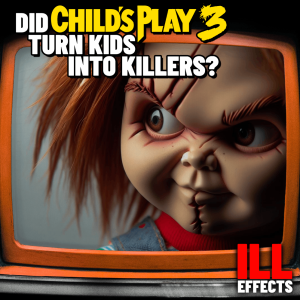
When two children murdered toddler James Bulger in 1993, the British media lost their damn minds and tried to blame a horror video. Rich tells Ben that this argument really started a decade earlier with the “video nasties” panic. Join us as we unravel a tangled web of sensationalism, fraudulent research, and some truly bizarre claims about dogs.
Show Notes:
Links and references:
Bailey, Susan (1996) “Adolescents who murder,” Journal of Adolescence, 19, 19-39.
Barker, Martin and Julian Petley, eds. (2001) Ill Effects: The Media/Violence Debate. Routledge. (Especially Barker’s chapter on the Newson Report)
Barker, Martin, ed. (1984) Video Nasties: Freedom and Censorship in the Media. Pluto Press. (Check out Brian Brown’s chapter for the incredible full story about Clifford Hill’s research)
Barlow, Geoffrey and Alison Hill, eds. (1985) Video Violence and Children. Hodder & Stoughton.
Cumberbatch, Guy (1994) “Legislating mythology: Video violence and children,” Journal of Mental Health, 3:4, 485-494.
Newson, Elizabeth (1994) “Video violence and the protection of children,” Journal of Mental Health, 3:2, 221-227
[Video] 'Suitable For Viewing In The Home ?' (Video Censorship & Video Nasties Documentary). YouTube.
[Film] Video Nasties: Moral Panic, Censorship & Videotape (2010). Dir. Jake West.
Note: Journal articles are often behind paywalls. If you don't have institutional access but would like a copy of these papers please email Illeffectspod@gmail.com and we will happily send you a copy.
Credits:
Hosts – Rich McCulloch and Ben Litherland
Music by - Brutalust (Colin Frank and Maria Sappho), recorded and mixed by Joe Christman
Creative producer – Rachel Wood
Technical producer – Caroline Pringle
Technical production – Colin Frank
Feb 26, 2024
Feb 26, 2024
1 min
Welcome to ILL EFFECTS - the good podcast about bad media influences. Can a horror film turn kids into killers? Can music make you more productive? Can a video game cause dangerous driving? Dr Rich McCulloch and Dr Ben Litherland investigate the bad faith arguments, dodgy data, and moral panics behind claims that the media influence our behaviour and manipulate our minds. Each episode they take a deep dive into the past and present of the media that have been said to cause any number of effects, researching music, video games, movies, books, toys, and more. What power does the media really have? Find out in the first series of bi-weekly discussions of Ill Effects. First two episodes released 29th February 2024
ILL EFFECTS
Can a horror film turn kids into killers? Can music make you more productive? Can a video game cause dangerous driving? Dr Rich McCulloch and Dr Ben Litherland investigate the bad faith arguments, dodgy data, and moral panics behind claims that the media influence our behaviour and manipulate our minds. Each episode they take a deep dive into the past and present of the media that have been said to cause any number of effects, researching music, video games, movies, books, toys, and more. What power does the media really have? Find out in the first series of bi-weekly discussions of Ill Effects.